Maya has been at her company for three years, earning $62,000. On Monday morning an email lands: a new role, a new title, and a salary of $66,960. Her first instinct is to feel flattered. Her second is to wonder what that number actually means. Is it a big raise, a small one, or a polite reshuffle? The answer is one division away, and once you can compute it, every offer letter, counteroffer, and annual review becomes a negotiation you can walk into holding numbers.
Step 1: Dollars first, percent second
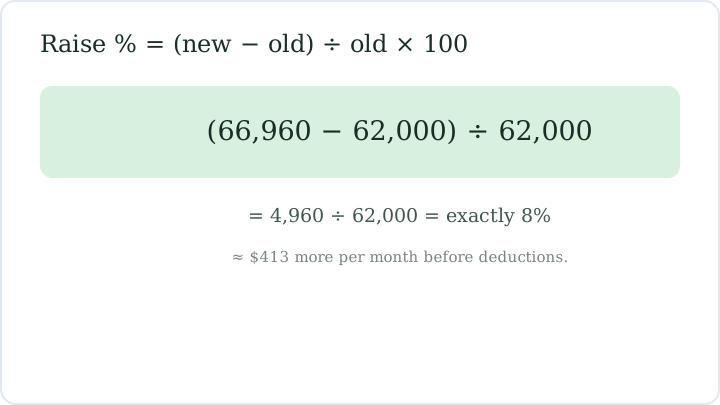
Start with the dollar gap, because it is the number you can verify instantly: 66,960 − 62,000 = 4,960. Maya's raise is $4,960 per year. To express it as a percentage of her current salary — the base — divide: 4,960 ÷ 62,000 = 0.08, which is exactly 8%. The formula is raise % = (new − old) ÷ old × 100. Always name the base out loud when you do this: the raise is 8% of the old salary, not of the new one. The same $4,960 on a $90,000 salary would be about 5.5%, which is why the percent, not the dollars, tells you how generous an offer really is.
Step 2: Translate it into monthly terms
Percentages feel abstract; rent is due monthly. Maya divides her $4,960 by 12 to get about $413 more per month (4,960 ÷ 12 = 413.33). Weekly, it is roughly $95 (4,960 ÷ 52 ≈ 95.38). These are pre-tax figures — a raise is taxed at your marginal rate, so the take-home lift is smaller, though every dollar of it is new money. The monthly view is also the honest test of a counteroffer: an extra $413 a month is a sentence a manager can weigh against a budget in a way that 8% sometimes cannot, especially across departments with very different salary bands.
Step 3: Check the raise against inflation
A raise only counts what it outruns. If prices rise 4% and your salary rises 3%, you did not gain 3% — you lost ground, because 1.03 ÷ 1.04 ≈ 0.99, a real-terms cut of about 1%. The quick subtraction (raise % − inflation %) gives a good estimate of your real raise. Do not anchor to any single inflation number from the news; rates move, and your personal basket of rent, gas, and childcare moves differently from the average. What stays true is the method, and it takes one line:
- Real raise ≈ salary growth % − price growth %.
- A 3% raise during 4% inflation is about a 1% pay cut in buying power.
- Maya's 8% clears a 4% price backdrop by a little under 4% in real terms (1.08 ÷ 1.04 ≈ 1.038).
Step 4: Counteroffer math, percent or dollars
Maya decides to counter, and the framing changes the psychology of the ask. On a $62,000 salary, asking for $3,000 sounds concrete but is only 4.8% (3,000 ÷ 62,000 ≈ 0.048). Asking for 10% names $6,200 — and lands the offer at $68,200 if accepted. Neither framing is dishonest; they emphasize different halves of the same arithmetic. Managers hear dollars as cost and percents as policy, so the same request can read as bold in one language and routine in the other. Convert in both directions before you speak, so nobody can surprise you with the version you did not compute:
- Dollars to percent: divide the ask by current salary (5,000 ÷ 62,000 ≈ 8.1%).
- Percent to dollars: multiply (10% of 62,000 = 6,200).
- Percent travels: 10% means the same thing to every reviewer; $6,200 needs salary context.
- Dollars anchor: a specific number can start the negotiation exactly where you want it.
Why 3% then 4% is not 7%
Suppose Maya instead stays put and takes 3% this year, 4% next year. Raises compound multiplicatively: 62,000 × 1.03 = 63,860, then 63,860 × 1.04 = 66,414.40. That is ×1.0712 in total — a 7.12% raise, not 7% — because the second raise is applied to an already-raised salary. The one-shot 8% offer of $66,960 beats the two-step path by $545.60 (66,960 − 66,414.40). Compounding cuts both ways: it rewards getting the big number early, and it quietly inflates a career of modest-sounding raises into serious money.
The raise grid: salary times percent
Before any negotiation, know your grid. Find your current salary row, slide across to the percent being discussed, and read the dollars — then run it in reverse when someone quotes dollars and you want the percent. Maya's row shows instantly why 8% felt substantial: it is nearly $5,000. The same table deflates small-percentage flattery at higher salaries, where 3% of $100,000 sounds generous until you divide by 12 and see it is $250 a month. A grid like this also makes annual review letters instantly checkable, because every promised percent maps to a dollar figure you already know how to judge.
| Current salary | 3% raise | 4% raise | 5% raise | 8% raise |
|---|---|---|---|---|
| $45,000 | $1,350 | $1,800 | $2,250 | $3,600 |
| $62,000 | $1,860 | $2,480 | $3,100 | $4,960 |
| $80,000 | $2,400 | $3,200 | $4,000 | $6,400 |
| $100,000 | $3,000 | $4,000 | $5,000 | $8,000 |
Enter the old salary and the offer into the percentage change calculator to confirm the raise percent before you reply to the email.
Open a calculator →Common questions
How much is an 8% raise on $62,000?
$4,960 a year, bringing the salary to $66,960. Multiply 62,000 by 0.08 to get 4,960; the check is that 4,960 ÷ 62,000 comes out to exactly 0.08. In monthly terms it is about $413 before tax.
Is a 3% raise good?
It depends entirely on inflation. If prices are rising faster than 3%, it is a real-terms cut of roughly the gap: at 4% inflation, 1.03 ÷ 1.04 ≈ 0.99, so about 1% of buying power is lost. If inflation is near 1%, the same raise is a solid real gain of about 2%.
How do I calculate a raise percentage?
Subtract the old salary from the new one, divide by the old salary, and multiply by 100. For $62,000 to $66,960: (66,960 − 62,000) ÷ 62,000 × 100 = 8%. The old salary is always the base — dividing by the new salary understates the raise.
Why do a 3% raise and a 4% raise total 7.12%?
Because the second raise compounds on the first. 1.03 × 1.04 = 1.0712, a 7.12% total gain. Adding the percentages (3 + 4 = 7) ignores that year two's 4% applies to a salary that has already grown 3%.
Should I negotiate in dollars or percentages?
Use both, deliberately. Dollars anchor the conversation to a specific figure; percentages make the ask comparable across salary bands and survive budget discussions held in rates. Convert whichever way the listener prefers: $5,000 on $62,000 is about 8.1%.
How do I convert my annual raise into a monthly amount?
Divide by 12. A $4,960 raise is about $413 a month (4,960 ÷ 12 = 413.33). The figure is pre-tax, so take-home rises by less, since the extra income is taxed at your marginal rate.
Our team checks formulas against worked examples and reviews every guide for clarity before publication. Spotted an error? Tell us — our editorial policy explains how corrections work.