Here is a quiet number: at 3% annual inflation, the money in your pocket loses half its buying power in a little over two decades. Nothing dramatic happens in any single year — prices tick up three cents on the dollar — yet compounding does the rest. This guide walks that same small percentage through four everyday places it hides: a grocery cart, a savings account, an annual raise, and a package that shrank. Same math, four disguises.
Inflation is interest in reverse
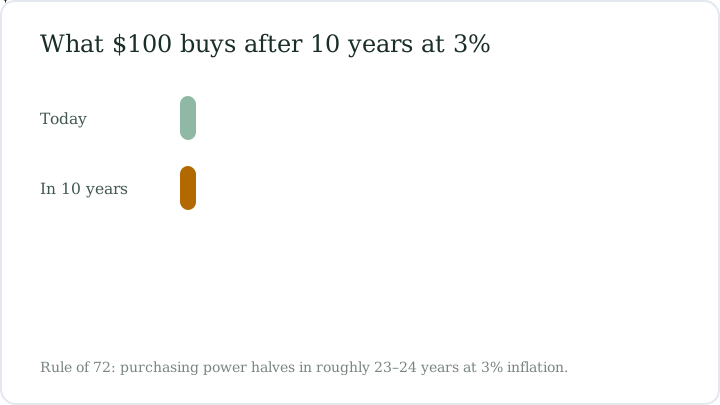
Interest multiplies your money; inflation divides what it buys. At 3%, $100 becomes $103 in a year — but goods cost 3% more, so your $103 buys what $100 ÷ 1.03 ≈ $97 bought before. To find when buying power halves, divide 72 by the rate: 72 ÷ 3 = 24 years, a close cousin of the exact logarithmic answer of about 23.4 years (ln 2 ÷ ln 1.03). Call it a little over two decades. And the effect compounds: ten years of 3% pushes prices to 1.03^10 ≈ 1.34, a 34% increase — not the 30% you would get by simply multiplying 3 by 10.
Scenario one: the grocery cart
A family spends $400 a month on groceries. If food prices rise 3% a year, the same cart costs 400 × 1.03 = $412 after one year — barely noticeable, easy to absorb. After ten years at the same rate, the multiplier is 1.03^10 ≈ 1.34, so the cart runs about $538 a month (400 × 1.3439 ≈ 537.57). That is $138 of extra monthly spending bought by a small-sounding percentage. Grocery inflation rarely matches the headline rate in any given year, but the mechanism is identical whatever rate your own basket experiences: multiply, wait, multiply again.
Scenario two: the savings account losing the race
Park $10,000 in an account paying 1% while prices rise 3%. After a year the statement proudly says $10,100 — a gain on paper. But divide by what things cost: 10,100 ÷ 1.03 ≈ $9,806 in last-year buying power. You are about $194 poorer in real terms while your balance grew. The balance is a costume; the division is the truth. The reverse holds too: an account paying 4% while prices rise 3% gains about 1% a year of real buying power — modest, but pointed the right way. Three habits keep the race honest:
- Compare rates, not balances: real return ≈ interest rate − inflation rate.
- A 1% account at 3% inflation loses roughly 2% a year of buying power.
- Recheck at every rate change — the gap, not the headline, decides the race.
Scenario three: the raise that got eaten
You earn $60,000 and receive a 2% raise: $61,200. If prices rose 3% that year, your real salary is 61,200 ÷ 1.03 ≈ $59,417 — about $583 behind where you started, despite the bigger paycheck. A raise is not a gain until it beats inflation; matching inflation is the finish line, not the prize. Over five years of 2% raises against 3% inflation, the gap compounds the same way prices do, leaving you with roughly $57,140 of starting-year buying power on that $60,000 salary.
Scenario four: shrinkflation, the hidden raise
Same price, smaller package — the label is quietly doing percentage math. A bag that goes from 500g to 450g at the same price has not held steady: the price per gram rose 500 ÷ 450 ≈ 1.111, an 11.1% increase. You are paying about 11% more for what you carry home, and no register ever shows it. It is the only percentage increase that arrives stamped with an unchanged price tag. Shoppers who track ounces rather than packages catch the move in a single division. Package size is now a moving part of the price, so treat it like one:
- Compare unit price — per gram, liter, or sheet — not package price.
- Recheck the unit price after any redesign; new look, new math.
- Apply the same division to size increases: 450g back to 500g is a real cut.
What $100 becomes at 2, 3, and 5 percent
The table shows the real value of $100 as inflation grinds on: divide 100 by (1 + rate) raised to the number of years. Two neighbors on the same street can live through the whole range. At 2%, a twenty-year-old $100 still buys about $67.30 of goods; at 5%, it buys about $37.69. Three points of rate, nearly half the value gone. Small differences between rates dominate any plan longer than a decade, which is the entire argument for noticing them now rather than later.
| Inflation rate | After 5 years | After 10 years | After 20 years |
|---|---|---|---|
| 2% | ≈ $90.57 | ≈ $82.03 | ≈ $67.30 |
| 3% | ≈ $86.26 | ≈ $74.41 | ≈ $55.37 |
| 5% | ≈ $78.35 | ≈ $61.39 | ≈ $37.69 |
Run any old-versus-new pair — prices or package sizes — through the percentage change calculator to expose the real increase.
Open a calculator →Common questions
How long does 3% inflation take to halve my buying power?
About 23 to 24 years. The rule of 72 gives 72 ÷ 3 = 24 years; the exact logarithmic answer is about 23.4 years, so a little over two decades either way. At 5% inflation, the same halving takes roughly 14 to 15 years.
What will $100 buy in 10 years at 3% inflation?
About $74.41 in today's terms: 100 ÷ 1.03^10 = 100 ÷ 1.3439 ≈ 74.41. Prices meanwhile would stand about 34% higher, which is the same fact seen from the other side of the division.
Is 2% inflation really much better than 3%?
Yes, over long spans. After 20 years, $100 retains about $67.30 at 2% but only $55.37 at 3% — an $11.93 gap created by a single percentage point. Compounding punishes small rate differences relentlessly.
How do I calculate shrinkflation?
Divide the old size by the new size and subtract 1. A 500g pack shrinking to 450g at the same price is 500 ÷ 450 ≈ 1.111, an 11.1% price increase per gram. Comparing unit prices at the shelf catches it every time.
Does my 1% savings account lose money at 3% inflation?
Yes, in real terms. A $10,000 balance grows to $10,100 but buys only about $9,806 worth of last year's goods — roughly a $194 real loss, or about 2% of buying power, despite the growing statement.
What is the rule of 72?
A mental shortcut for doubling times: divide 72 by the growth rate to estimate the years. At 3%, prices double in about 24 years (72 ÷ 3). It tracks the exact logarithmic answer closely for the small rates that describe inflation.
Our team checks formulas against worked examples and reviews every guide for clarity before publication. Spotted an error? Tell us — our editorial policy explains how corrections work.