The receipt from an Amsterdam shop reads like a mistake: the tag said €242, the register charged €242, and there is no tax line anywhere. Nothing is missing. In most of the world, the consumption tax — VAT, or GST in some countries — is already inside the displayed price, and the receipt has nothing left to add. That one difference flips every calculation you learned from US receipts. This guide runs the comparison, then works the two operations travelers and small sellers actually need: pulling tax out of a gross price, and building it back in when you set your own.
Two systems, one comparison table
Read this table as a translation device, not trivia. A US shopper meets the tax at the register, added on top of the shelf price. A shopper in a VAT country meets it on the shelf, already included — commonly around 20–23% as the standard rate across much of Europe, though rates vary by country and change over time. Sellers feel the deeper difference: VAT is charged at each stage of production, with businesses typically reclaiming the tax they paid on inputs, so the full burden lands on the final consumer. Sales tax, by contrast, is collected once, at the final sale.
| Feature | US-style sales tax | VAT / GST |
|---|---|---|
| Where you meet it | Added at the register | Already inside the displayed price |
| Rate base | Final sale price, added on top | Each stage, credited back to businesses |
| Typical standard rate | 0–10% combined, varying by state and city | Commonly ~20–23% in much of Europe (varies, changes) |
| Refund for travelers | Generally no | Often reclaimable at departure — rules vary by country |
Pulling VAT out of a gross price
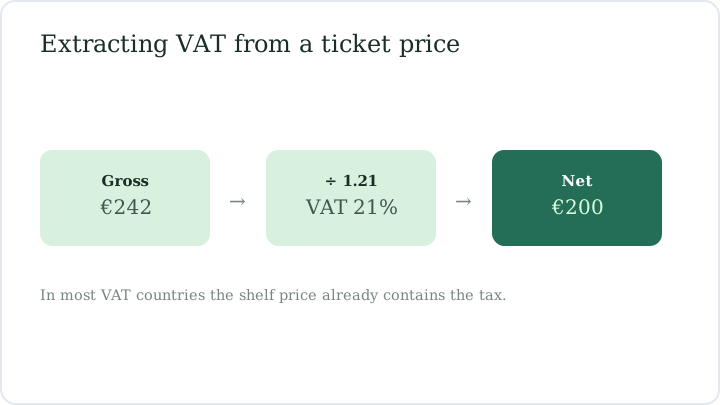
A €242 invoice includes 21% VAT, and an expense report needs the net. The formula: net = gross ÷ (1 + rate). So €242 ÷ 1.21 = €200 net, and the VAT inside is €242 − €200 = €42. The division works because the gross price is 121% of the net — gross = net × 1.21 — and dividing undoes that multiplication. The tempting shortcut, subtracting 21% of €242, gives €242 − €50.82 = €191.18. Wrong by €8.82, because 21% was charged on €200, not on €242. Same trap as reversing any percentage increase: the base moves, so you divide, never subtract.
| Method on a €242 gross at 21% | Result | Verdict |
|---|---|---|
| €242 ÷ 1.21 | €200.00 net, €42.00 VAT | Correct — undoes the × 1.21 |
| €242 − (21% of €242) | €191.18 | Wrong — uses the gross, not the net, as the base |
Adding VAT: the small seller's direction
A seller runs the same machine forward. You knit scarves, materials cost you €12 each, and you decide €40 is a fair net price. The shelf price must include VAT: €40 × 1.21 = €48.40, of which €8.40 is tax you collect for the government. The checklist feels rigid the first month and automatic after that: pick the net price your business actually earns, multiply by (1 + rate), tag the gross. When a customer asks what they are paying in tax, run yesterday's receipt backward — a €48.40 sale is €48.40 ÷ 1.21 = €40.00 net plus €8.40 VAT. Adding and removing are inverse operations on the same factor.
- Forward (pricing): shelf price = net price × (1 + VAT rate).
- Backward (bookkeeping): net = gross ÷ (1 + VAT rate).
- The VAT amount is the difference between the two, never the rate times the gross.
- Businesses typically reclaim VAT paid on their own purchases — the final consumer carries it.
The extraction table for common rates
Every extraction is one division by (1 + rate), and the common rates deserve memorized divisors. The 20–23% cluster covers much of Europe's standard rates as of recent years; 5% and 10% appear as reduced rates for things like food, books, or medicine, depending on the country. Check the €50 row carefully: at 23%, the net is €40.65, not a tidy €40 — real invoices rarely land on round numbers, which is exactly why the division matters. The last column is the number that goes on the tax line of a claim form.
| Rate | Divide the gross by | Example | Net | Tax inside |
|---|---|---|---|---|
| 5% | 1.05 | £105 | £100.00 | £5.00 |
| 10% | 1.10 | €44 | €40.00 | €4.00 |
| 19% | 1.19 | €119 | €100.00 | €19.00 |
| 20% | 1.20 | £240 | £200.00 | £40.00 |
| 21% | 1.21 | €242 | €200.00 | €42.00 |
| 23% | 1.23 | €50 | €40.65 | €9.35 |
The traveler's refund is the extracted tax
Many countries let travelers reclaim VAT on goods they take home, commonly at the airport before departure — though rules, minimum spends, and fees vary by country and change often, so check current requirements before you count on it. The arithmetic ceiling on any refund is the VAT inside the price, which you now know how to find. On that €242 purchase at 21%, the maximum back is €42 — the €242 ÷ 1.21 extraction — not 21% of €242, which would be €50.82 and was never charged on the gross. Refund services take a cut, so the money that actually returns is the €42 minus fees, and only on purchases that qualify.
- Maximum refund = gross − (gross ÷ (1 + rate)), e.g., €242 − €200 = €42 at 21%.
- Ask for the refund form at purchase; some sellers will not issue it later.
- Minimums, eligible goods, and validation steps differ by country — verify current rules.
One factor, both directions
Strip the currency symbols and country names, and VAT math is the reverse-percentage pattern wearing a passport. Build the factor (1 + rate), multiply to go from net to gross, divide to come back. The same skeleton handles a €55 net price tagged for a 21% country (€55 × 1.21 = €66.55 shelf price) and a €119 gross in a 19% country (€119 ÷ 1.19 = €100 net, €19 VAT). Small sellers crossing borders do this constantly — one product page, several tax regions, one factor each. Keep the divisors in the table above taped to the invoice folder and the whole system collapses to two operations.
Run any tax-inclusive price through the reverse percentage calculator with your VAT rate to split the net from the tax in one step.
Open a calculator →Common questions
How do I remove 21% VAT from a price?
Divide the gross price by 1.21. A €242 charge is €242 ÷ 1.21 = €200 net with €42 of VAT inside. Subtracting 21% of €242 instead gives €191.18 — wrong, because VAT was 21% of the net, not the gross.
Is VAT the same thing as sales tax?
No. Sales tax is added once, at the final register, on top of the displayed price. VAT (and its cousin GST) is included in the displayed price and is charged at each production stage, with businesses typically reclaiming what they paid on inputs. The consumer burden is comparable; the collection mechanics differ.
Why is the VAT not just 21% of the sticker price?
Because the sticker is the net plus the tax — 121% of the net. 21% of €242 is €50.82, but the tax actually charged was 21% of the €200 net, or €42. Percentages attach to a base, and the base for VAT is always the pre-tax amount.
Can tourists get VAT refunded at the airport?
Often, yes. Many countries allow travelers to reclaim VAT on goods exported in their luggage, commonly processed at departure — but minimum spends, eligible goods, and fees vary by country and change frequently. The most you can get back is the extracted tax: €42 on a €242 purchase at 21%, before any service fees.
What is the difference between VAT and GST?
Mechanically, almost nothing — GST (goods and services tax) is the same value-added mechanism under a different name, used in countries such as Australia, New Zealand, Canada, and India. For your math, both work identically: divide the gross by (1 + rate) to find the net, multiply the net by (1 + rate) to build a shelf price.
How do I set a shelf price that includes VAT?
Choose your net price first, then multiply by (1 + rate). Wanting €40 net before 21% VAT means a shelf price of €40 × 1.21 = €48.40. Setting the shelf first and dividing afterward shrinks your margin every time, so always price forward from the net.
Our team checks formulas against worked examples and reviews every guide for clarity before publication. Spotted an error? Tell us — our editorial policy explains how corrections work.