Two headlines cover the same jobs report. One says 'Unemployment up 2 points to 7%.' The other says 'Unemployment jumps 40%.' Readers argue in the comments, each certain the other side is lying. Both headlines are accurate. The jobless rate rose from 5 percent to 7 percent: that is 2 percentage points if you subtract the rates, and 40 percent if you divide the change by the base. Neither number is wrong; they measure different things, and the space between them is exactly where news consumers get misled. This guide makes the two calculations automatic, then tests them on real headline patterns.
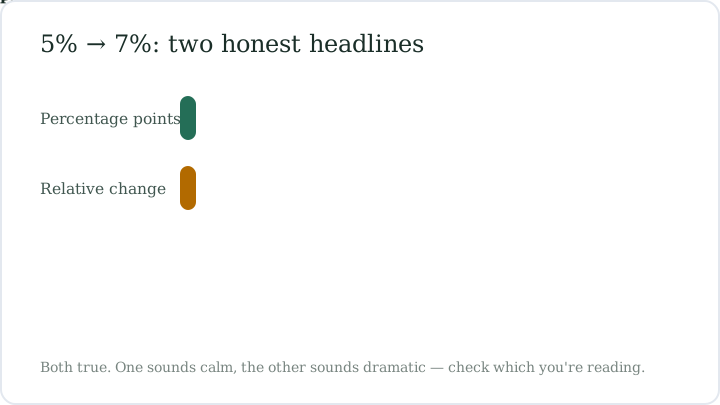
Two calculations, one rate move
Percentage points measure the arithmetic gap between two percentages: 7 minus 5 is +2 points. Percent change measures the relative move against a base: the change, 2, divided by the starting rate, 5, times 100 - which is 40 percent. The formulas differ only in the denominator, but that denominator is everything. Points answer 'how far did the rate itself move?' Relative change answers 'how big was that move compared with where it started?' Both are legitimate, and each misleads when presented as if it were the other. Whenever a percentage changes, you can compute both numbers - honest reporting tells you which one it is using.
The comparison table
Run both calculations across five rate moves and the pattern jumps out. The first three rows are all +2-point moves, yet the relative change runs from about 66.7 percent down to 20 percent - the smaller the base, the louder the relative claim. The 2-to-3 row is the trap worth memorizing: a single percentage point becomes a 50 percent increase, because the base is only 2. The 40-to-44 row shows the opposite effect: a 4-point move on a big base shrinks to a 10 percent relative change. Anyone quoting these numbers can make the same event feel explosive or marginal - honestly - simply by choosing which row of the table to emphasize.
| Rate move | In percentage points | In percent change |
|---|---|---|
| 3% to 5% | +2 points | about 66.7% (2 ÷ 3) |
| 5% to 7% | +2 points | 40% (2 ÷ 5) |
| 10% to 12% | +2 points | 20% (2 ÷ 10) |
| 2% to 3% | +1 point | 50% (1 ÷ 2) |
| 40% to 44% | +4 points | 10% (4 ÷ 40) |
Where you meet this: rates, polls, mortgages
The confusion concentrates in a few regular beats of the news cycle. Unemployment reports usually speak points - 'up half a point' - because what touches lives is the level of the rate. Interest-rate coverage mixes both: a mortgage rate moving from 4 percent to 5 percent is +1 point but +25 percent in relative terms, and a monthly payment feels the point, not the percentage. Approval ratings drift in points (44 percent from 40 is +4 points, a 10 percent relative gain), while campaigns quote whichever number flatters them that week. Central banks add a third unit - basis points, hundredths of a point - so 'raised 25 basis points' means 0.25 of a point, not 25 percent of anything.
How to read a claim without being fooled
Reading percentage claims in the news becomes a three-second habit once trained. First, find the base: what was the rate before? If the story never says, the claim is already suspect, because percent change is meaningless without its starting point. Second, look for the word 'points,' which signals the arithmetic gap rather than relative growth. Third, recompute both numbers yourself - subtract for points, divide by the base for relative change - and see which one the headline actually used. Finally, ask which framing the writer chose and who benefits from it. None of this arithmetic takes longer than a breath; the entire defense is knowing that two different numbers exist.
- Find the base rate before believing any percent-change claim.
- The word 'points' signals subtraction of rates, not relative growth.
- Recompute both readings: the point gap and the relative change.
- Both numbers can be true at once - ambiguity, not error, is the risk.
Quiz yourself on real patterns
Each row below is a claim you could read this week, with the actual move filled in. Cover the two right-hand columns and compute before checking. The mortgage claim, 'rates up 25 percent,' is the classic: from 4 percent to 5 percent is +1 point and exactly 25 percent relative - the number is right, but borrowers feel points in their payment. The turnout claim reports points honestly, though 5 points on a 50 percent base is a 10 percent relative move. The approval claim, 'fell about 9 percent,' quietly hides a 4-point drop. If you computed all three correctly and quickly, the habit is yours.
| Claim | Actual move | In points | In percent change |
|---|---|---|---|
| Mortgage rates 'up 25%' | 4% to 5% | +1 point | +25% |
| Turnout 'up 5 points' | 50% to 55% | +5 points | +10% |
| Approval 'fell about 9%' | 44% to 40% | -4 points | about -9.1% |
Which one should you use?
Use points when the level of the rate is what touches lives: a mortgage payment, an unemployment threshold, a vaccine uptake target. Points preserve the size of the move in the units people actually experience. Use relative change when growth or acceleration is the story: how quickly a figure is doubling, whether a trend is speeding up. When the stakes are high, report both numbers plus the base - 'up 2 points, from 5 to 7 percent, a 40 percent relative increase' - because the pair is nearly impossible to spin. Misleading coverage relies on readers knowing only one of the two readings; carry both.
- Use points when the rate level itself affects people - payments, thresholds, seats.
- Use relative change when the story is the speed of growth or acceleration.
- Maximum honesty: give both numbers and name the starting rate.
Enter the two rates into the percentage change calculator to see both readings - the point gap and the relative move - side by side.
Open a calculator →Common questions
What is a percentage point?
One whole unit of a percentage. A move from 5 percent to 7 percent is an increase of 2 percentage points - plain subtraction of the two rates. Points measure how far the rate itself moved, independent of how large the rate was to begin with.
How much is 2 percentage points in percent change?
It depends entirely on the base. Two points from 5 percent is a 40 percent increase; two points from 10 percent is 20 percent. Divide the point gap by the starting rate to convert between the two readings. There is no single conversion, which is why headlines that skip the base mislead.
Can both numbers be correct at the same time?
Yes. A rate rising from 5 to 7 percent is simultaneously +2 points and +40 percent relative change. They are different measurements of the same event, not rival claims. Trouble starts only when a writer uses one while implying the other.
What are basis points?
Hundredths of a percentage point. One point equals 100 basis points, so 'rates up 25 basis points' means 0.25 of a point. Finance adopted them to avoid exactly the points-versus-percent ambiguity this guide describes. A move from 3.00 to 3.25 percent is 25 basis points.
Why do small rates produce huge percent changes?
Because the base is small. Moving from 2 percent to 3 percent is +1 point but +50 percent relative - the 1-point gain is half of the 2 percent starting point. The smaller the base, the more dramatic relative change sounds for the same point move. Always ask for the starting rate before deciding how dramatic a claim is.
Which should I use in my own report or post?
State both, or state points plus the base rate. A claim like 'up 2 points, from 5 percent' cannot be misread, while 'up 40 percent' forces readers to reconstruct the base themselves. Naming the starting rate is the entire courtesy, and it costs one clause.
Our team checks formulas against worked examples and reviews every guide for clarity before publication. Spotted an error? Tell us — our editorial policy explains how corrections work.