Which is better: $25 off or 30% off? The honest answer is that the coupon is not the deal — the price tag is. On a $60 printer, the dollars win by $7. On a $300 printer, the percent wins by $65. One comparison decides every version of this choice, and you can run it in your head in about ten seconds while standing at the shelf. This guide gives you the rule, the crossover prices worth memorizing, and the traps stores build around both.
The ten-second rule
Compute what the percent is worth in dollars, then compare it to the coupon. On a $90 jacket, 30% is 0.30 × 90 = $27, and $27 beats $25 — take the percent. On a $60 printer, the same test hands the win to the dollars, since 30% of 60 is only $18. In your head: slide the decimal one place to get 10% ($9), multiply by 3 for 30% ($27), compare. That is the entire decision procedure, it works at any price, and it never changes direction halfway through a purchase:
- Dollar-off wins when the dollars exceed percent × price ÷ 100.
- Percent-off wins when percent × price ÷ 100 exceeds the dollars.
- A tie means pick either — or whichever has fewer strings attached.
The crossover price
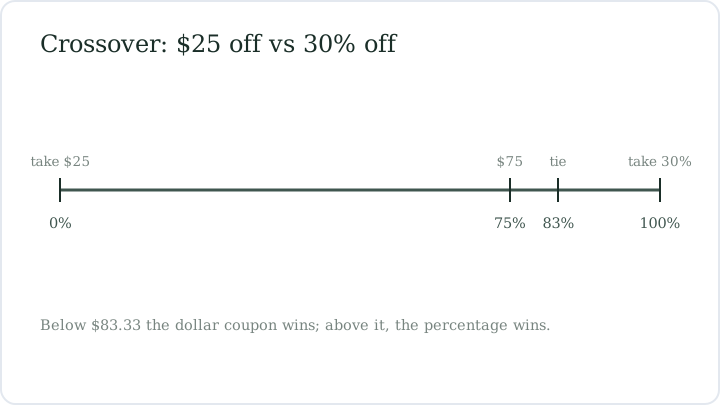
Every dollar-versus-percent pair has exactly one price where they tie. For $25 off against 30% off, solve 0.30 × price = 25, giving price = $83.33. Below $83.33 the dollars win — at $70, 30% is only $21. Above it the percent wins — at $100, 30% is $30. The crossover is the only number worth memorizing for a coupon pair, because the decision flips exactly once, at that price, and nowhere else. Check your cart against it before you reach the register, not after the receipt prints.
Decision table: three more crossovers
Common coupon pairs, worked the same way — divide the dollars by the percentage written as a decimal. Fifteen dollars against 20% crosses at 15 ÷ 0.20 = $75; forty against 15% at 40 ÷ 0.15 = $266.67. The last row is the sneakiest: a $10-off-$50 coupon ties a plain 20% off at exactly $50 — $10 either way — and since the coupon requires a $50 minimum, every cart above $50 favors the percent. The minimum steers you toward the one price where the coupon gains you nothing while feeling like a reward.
| Deal pair | Crossover price | Take the dollars when | Take the percent when |
|---|---|---|---|
| $15 off vs 20% off | $75.00 | Price is under $75 | Price is over $75 |
| $25 off vs 30% off | $83.33 | Price is under $83.33 | Price is over $83.33 |
| $40 off vs 15% off | $266.67 | Price is under $266.67 | Price is over $266.67 |
| $10 off $50 vs 20% off | $50.00 tie | Never — the minimum blocks it | Price is $50 or more |
When the tag is already marked down
Percent-off offers apply to one specific number: the price you are actually charged, not the crossed-out original — unless the fine print says otherwise. A sweater ticketed at $80, down from $110, with a choice of $25 off or 30% off is decided on the $80: 30% is $24, so the dollars win by $1. The $110 exists to make both options feel generous. Before choosing, confirm which price the percent multiplies; stores run both rules, and only the receipt settles which one was used.
Stacking: order changes the total
When you can use both a percent and a dollar coupon, the order of operations changes what you pay. On a $60 basket, dollars first gives (60 − 10) × 0.80 = $40, while percent first gives 60 × 0.80 − 10 = $38. Same coupons, $2 apart. For the shopper, subtracting the percent first and the dollars last is always the cheaper order; registers, quite naturally, tend to be programmed the other way. Stacking is also where exclusions hide, so check whether the dollar coupon still applies after a percentage has already been taken.
Minimum-purchase traps
A minimum-purchase coupon is a spending dare. The store is betting that whatever you add to reach the threshold costs more than the discount saves — and the bet usually pays. A cart at $57 facing a $10-off-$60 coupon invites a $10 filler that leaves you paying exactly what you would have, $57, while carrying home a product you never planned to buy. The fix predates coupons: know what the item is worth to you before any discount quotes a price. Treat filler as a cost, not a freebie, and audit it before the register does:
- Only add items you would have bought anyway to reach the minimum.
- If the filler costs more than the extra discount, the coupon is costing you money.
- Compare against the plain percent-off deal at the same cart — sometimes it wins with no minimum at all.
Type the shelf price into the discount calculator, then hold the result next to the dollar coupon before you pick one.
Open a calculator →Common questions
Is $25 off better than 30% off?
It depends on the price, and the cutoff is $83.33. Below it the dollars win (at $70, 30% is only $21); above it the percent wins (at $100, 30% is $30). Solve 0.30 × price = 25 to find the crossover in one step.
Is 20% off the same as $20 off?
Only at a $100 price, where both take $20. Under $100 the dollars win; over $100 the percent wins. At $80, 20% is $16 — four dollars worse than a $20 coupon.
Which coupon should apply first when stacking?
The percentage first, then the dollars. On a $60 basket, percent-first lands at $38 versus $40 for dollars-first — the same coupons, $2 apart. Registers often run the other order, so check which sequence the store allows before loading the cart.
Why do stores put a $50 minimum on a $10 coupon?
Because at exactly $50 the coupon only ties a plain 20% off — $10 either way — and every cart above $50 would do better with the percent. The minimum funnels you to the price where the coupon saves you nothing while still feeling like a reward.
How do I decide in my head at the shelf?
Slide the decimal to get 10% of the price, scale it to the coupon's percent, and compare with the dollar amount. On $90: 10% is $9, so 30% is $27 — that beats $25, and the arithmetic takes about two seconds.
Do percent-off deals apply to sale prices?
Sometimes. Each store decides whether the percent multiplies the ticketed price or the original, and the honest comparison uses the price you would actually pay. At $80 ticketed, 30% is $24 — so confirm on the receipt which base was charged.
Our team checks formulas against worked examples and reviews every guide for clarity before publication. Spotted an error? Tell us — our editorial policy explains how corrections work.