Take one pair of $100 headphones on a road trip. In Portland, Oregon, they ring up at $100. In many states, the register adds about $6. In Los Angeles, they cost $107.25. Cross into certain cities and the total can pass $110 — same headphones, same sticker, four different prices. Sales tax is the percentage quietly deciding what you actually pay, and unlike most math on a receipt, it changes with geography. This tour follows four people — a shopper, a small seller, an online buyer, and a back-to-school parent — through the same one-step formula.
Scenario one: the shopper crossing state lines
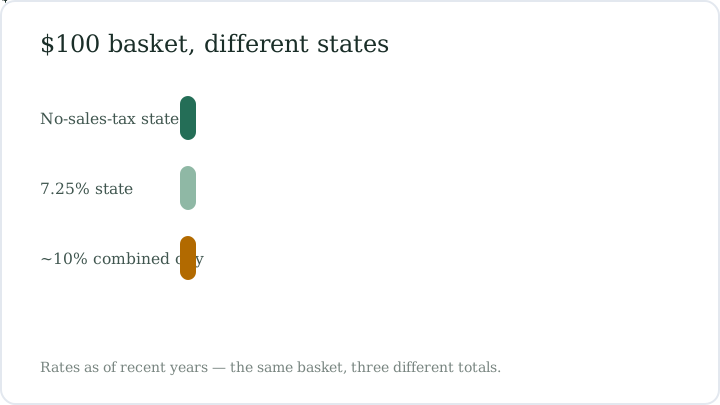
The core formula is one multiplication: tax = price × rate. A $100 purchase at a 6% rate pays $100 × 0.06 = $6, for a total of $106. California's state-level rate, the highest in the country at 7.25% as of recent years, makes the same purchase $107.25. Cities and counties stack their own rates on top, and combined state-plus-local rates exceed 10% in some cities — at 10.25%, the headphones cost $110.25. Rates change often, so treat every number here as a snapshot, not a promise. The method never changes even when the rates do.
| Where the $100 item is rung up | Combined rate | Tax | Total |
|---|---|---|---|
| Portland, Oregon (no state sales tax) | 0% | $0.00 | $100.00 |
| A typical 6% state | 6% | $6.00 | $106.00 |
| Los Angeles, California (highest state rate) | 7.25% | $7.25 | $107.25 |
| A city where local rates stack high | 10.25% | $10.25 | $110.25 |
The mental math for any shelf price
You rarely have a calculator in a checkout line, but you can estimate the tax in seconds. Take an $84 backpack at 7.25%. Split the rate: 5% of $84 is $4.20, 2% is $1.68, and 0.25% is $0.21. Add them and the tax is $6.09, making the real cost $90.09. A rough version is faster: 7.25% is close to 7.5%, which is 7.5 cents per dollar, or about $6.30 on $84 — within a quarter of the exact answer. Estimating before the register means no surprises when the total appears, and it catches scanner errors for free.
- 10% of the price is the decimal slid one place left: $84 becomes $8.40.
- Build other rates from that: 5% is half of it, 20% is double, 7.25% is 5% + 2% + 0.25%.
- Round the rate to a nearby easy number when you only need a sanity check.
Scenario two: the seller reading an all-in receipt
A seller's card statement often shows one combined number — tax included — and the bookkeeping needs the split. This is the reverse operation, and the instinct (subtract 7.25% of the total) lands wrong because the total is bigger than the pre-tax price. Instead divide: pre-tax price = total ÷ (1 + rate). A $107.25 total at 7.25% comes from $107.25 ÷ 1.0725 = $100.00 exactly. A $120 total at the same rate is $120 ÷ 1.0725 = about $111.89 before tax, with $8.11 of tax inside. The division works because the total is 107.25% of the shelf price, and dividing undoes that multiplication.
| All-in total | Rate | Pre-tax price | Tax inside |
|---|---|---|---|
| $107.25 | 7.25% | $107.25 ÷ 1.0725 = $100.00 | $7.25 |
| $120.00 | 7.25% | $120 ÷ 1.0725 ≈ $111.89 | $8.11 |
Why five states charge nothing
As of recent years, five states levy no state-level sales tax at all: Alaska, Delaware, Montana, New Hampshire, and Oregon. Even here there is a footnote — Alaska allows its cities and boroughs to charge local sales taxes, so parts of Alaska are not zero. New Hampshire skews the map in another way: no sales tax on most goods, but taxes do apply in specific categories. The reason for the spread is political, not mathematical. Sales tax funds state budgets, and states that raise the same money through income or resource taxes can skip it. For you, the shopper, the formula just runs with a zero.
- No state-level sales tax: Alaska (local taxes allowed), Delaware, Montana, New Hampshire, Oregon.
- Highest state-level rate: California at 7.25%.
- Combined state + local rates top 10% in some cities.
- Rates move with legislation — recheck before relying on any figure.
Scenario three: the online order
Online sales tax used to be a loophole; it mostly is not anymore. Following court rulings and state laws adopted in recent years, major retailers now collect sales tax at checkout based on the delivery address, so the buyer in Los Angeles pays Los Angeles rates even when the warehouse sits in Nevada. Smaller sellers are handled through thresholds: once a seller crosses a state's sales or transaction count, that state can require collection. The practical upshot for shoppers is that the math is identical to a store — tax = price × your local combined rate — and the checkout page shows the line before you confirm. If no tax line appears, the seller is small or the item is exempt, not the math being suspended.
Scenario four: the tax-free weekend shopper
Some states run sales-tax holidays — a weekend, usually in late summer, when certain items (clothing, school supplies, computers under a price cap) are exempt from sales tax. The saving is exactly the tax you would have paid: on $200 of eligible clothing at 7.25%, that is $14.50. The percentage math does not change; the rate simply drops to zero for eligible baskets. The catches live in the details: price caps per item, exempt categories, and participating states all shift year to year, so check the current rules before planning a trip. A holiday is a genuine discount of (rate × eligible spend) — nothing more, which is why big-ticket items outside the caps save you nothing.
- Saving = your combined rate × eligible subtotal, e.g., 7.25% × $200 = $14.50.
- Item price caps decide eligibility, not the receipt total.
- Not all states participate, and dates change annually — verify before you shop.
Why other countries confuse American travelers
In most other countries, the tax is already inside the shelf price, so a tag that says 42 means you pay 42 — the receipt shows no surprise line. The United States mostly does the opposite: taxes are added at the register, which is why the shelf says $100 and the card slip says $107.25. Neither system is hiding anything; they just answer different questions. The American tag answers 'what does the item cost?' and the register answers 'what do you owe?'. Elsewhere the tag answers both at once. Travelers who know this stop recalculating at every register — and travelers going the other way stop being startled by the add-on at theirs.
Enter the shelf price and your combined rate into the percentage calculator to preview the tax and total before you reach the register.
Open a calculator →Common questions
How do I calculate sales tax on a price?
Multiply the price by the rate written as a decimal. A $60 item at 6.5% owes $60 × 0.065 = $3.90 in tax, for a $63.90 total. The rate to use is the combined state-plus-local rate where you take delivery, not where the store is based.
How do I back the sales tax out of a total?
Divide the total by 1 plus the rate: $106 at 6% gives $106 ÷ 1.06 = $100 pre-tax with $6 of tax inside. Subtracting 6% of $106 instead gives $99.64 — wrong, because the tax was 6% of the pre-tax price, not of the total.
Which states have no sales tax?
Five, as of recent years: Alaska, Delaware, Montana, New Hampshire, and Oregon. Alaska still allows local sales taxes, so parts of it are not zero. Rates change with legislation, so confirm current figures before a big purchase.
What is the highest sales tax rate in the US?
California has the highest state-level rate at 7.25%, and combined state-plus-local rates can exceed 10% in some cities. That is why the same $100 item can ring up anywhere from $100 to over $110 across the country.
Do I pay sales tax on online orders?
Usually yes. Most large retailers collect at checkout based on your delivery address, and most states require smaller sellers to collect once they pass a sales or transaction threshold. The rate is your local combined rate, same as a physical store.
What is a sales tax holiday?
A window, typically a late-summer weekend, when a state suspends sales tax on eligible items like clothing and school supplies, often with per-item price caps. Your saving equals your normal rate times the eligible subtotal — 7.25% on $200 is $14.50.
Our team checks formulas against worked examples and reviews every guide for clarity before publication. Spotted an error? Tell us — our editorial policy explains how corrections work.