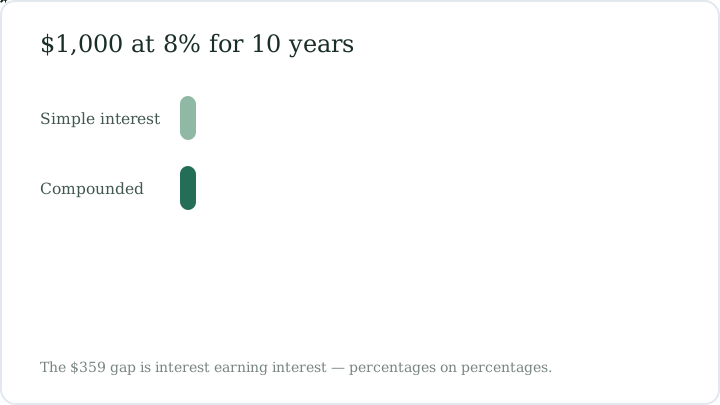
Which pays more: $1,000 at 8% for ten years, or $1,000 at 8% for ten years? The question is not a typo — the answer depends entirely on how the percentage behaves. If the interest is simple, you earn $800. If it compounds, you earn $1,158.92. Same rate, same decade, $358.92 apart, and the gap widens every year beyond ten. Compound interest is the moment a percentage stops being a slice of a fixed number and becomes a percentage of a number that itself keeps growing. This guide climbs that idea one rung at a time, from a single year to the full formula.
Rung one: a percentage of what?
Start with the ordinary percentage you already own. 8% of $1,000 is $80, because 0.08 × 1,000 = 80. After one year, the account holds $1,080. This is percent-of: a slice of one fixed base. Simple interest stays here forever — it keeps taking 8% of the original $1,000, paying $80 every year, which totals $800 of interest over ten years. Nothing wrong with that, and nothing interesting either. The ladder begins when year two asks a slightly different question: 8% of which number?
Rung two: the same percent, a bigger base
Compound interest takes its percentage of the whole balance, not the original deposit. Year two charges 8% on $1,080, adding $86.40 and ending at $1,166.40. Year three adds 8% of $1,166.40, which is $93.31, landing at $1,259.71. This is percent-on-percent: each year's interest becomes part of the base for the next year's percentage. Notice the pattern in the interest column — $80.00, $86.40, $93.31 — each payment larger than the last, without the rate ever changing. The rate is constant; the thing it multiplies is not.
| Year | 8% of the balance | Interest earned | Year-end balance |
|---|---|---|---|
| 1 | 8% × $1,000.00 | $80.00 | $1,080.00 |
| 2 | 8% × $1,080.00 | $86.40 | $1,166.40 |
| 3 | 8% × $1,166.40 | $93.31 | $1,259.71 |
Rung three: multiplication, repeated
You can ladder year by year forever, but the pattern compresses. Each year multiplies the balance by 1.08, so ten years is ten multiplications: $1,000 × 1.08 × 1.08 × ... ten times, written $1,000 × 1.08^10. Run it and the answer is $2,158.92 — about $2,159 — against $1,800 for simple interest. The $358.92 difference is pure percent-on-percent: interest that earned its own interest. One habit worth keeping from this rung: 1.08 is the growth factor, 100% of the balance plus the 8% rate, and every compound rate builds its factor the same way — 5% means ×1.05, 12% means ×1.12.
Rung four: the formula, gently
The general formula is A = P × (1 + r/n)^(n × t). Read it as a cast list: P is the starting principal, r the annual rate as a decimal, n how many times per year interest is added, t the years, and A the ending amount. At 8% added once a year, n = 1 and the formula collapses into rung three: A = 1,000 × 1.08^10 = $2,158.92. At 8% added monthly, n = 12, and the same decade ends at $2,219.64 — about $61 more, from the same nominal rate, because each month's interest starts earning a little sooner. That is the whole trick behind APY quotes on savings accounts.
- P = principal (the $1,000), r = rate as a decimal (0.08), t = years.
- n = compounding periods per year: 1 annual, 12 monthly, 365 daily.
- More frequent compounding always ends higher at the same nominal rate — monthly beat annual by about $61 over the decade.
Rung five: the Rule of 72
Before calculators fit in pockets, bankers needed a fast estimate for doubling time, and the trick still wins bar bets. Divide 72 by the annual rate, and you get roughly the years to double: at 8%, 72 ÷ 8 = 9 years. Check it against the real math and it lands nearly perfect — 1.08^9 = 1.999, so $1,000 becomes $1,999 in nine years. At 6%, the rule predicts 12 years, and 1.06^12 = 2.01. The estimate drifts at extreme rates but is remarkably tight through the 4–10% range where savings and loans actually live. Two seconds of division buys you the shape of any compounding curve.
Rung six: the same math on debt
Every rung so far has paid you. Now turn the ladder around, because credit card debt compounds against the borrower with the identical formula. A $2,000 balance at 24% APR, compounded monthly and left alone for one year, becomes 2,000 × 1.02^12 = $2,536.48 — a $536.48 bill for borrowing $2,000, with not a single new purchase. The 2% is the monthly slice of the 24% annual rate, and twelve compounding rounds do the rest. This is why minimum payments are engineered to feel affordable: they cover the interest and barely dent the principal, keeping the percent-on-percent machine running on your side of the table.
- Debt uses the same A = P(1 + r/n)^(nt) — the balance is the P.
- Minimum payments mostly cover interest, so the base keeps compounding.
- Any payment above the interest line actually shrinks the base the rate multiplies.
The long view: rate × time
The final rung is a table, because compound interest only gets dramatic when you zoom out. Each cell is $1,000 grown at the stated rate, rounded to whole dollars. Read the corners: at 4% for 30 years you roughly triple your money; at 10% for 30 years you end near $17,449 — more than seventeen times the start. The difference between 6% and 8% looks small on a rate sheet and enormous on the 30-year row, which is why the Rule of 72's doubling logic matters: 72 ÷ 6 = 12 years to double, 72 ÷ 8 = 9, and several doublings stacked is how $1,000 becomes $10,063.
| Annual rate | 10 years | 20 years | 30 years |
|---|---|---|---|
| 4% | ≈ $1,480 | ≈ $2,191 | ≈ $3,243 |
| 6% | ≈ $1,791 | ≈ $3,207 | ≈ $5,743 |
| 8% | ≈ $2,159 | ≈ $4,661 | ≈ $10,063 |
| 10% | ≈ $2,594 | ≈ $6,727 | ≈ $17,449 |
Plug your principal, rate, and years into the compound percentage calculator to watch each rung of the ladder fill in with real numbers.
Open a calculator →Common questions
What is compound interest in one sentence?
It is interest earned on interest — each period's percentage applies to the grown balance, not the original deposit. $1,000 at 8% for 10 years ends at $2,158.92 rather than the $1,800 simple interest would pay, because every year's $80-plus keeps joining the base.
How much is $1,000 at 8% interest for 10 years?
About $2,159 with annual compounding: 1,000 × 1.08^10 = $2,158.92. Simple interest would give exactly $1,800, so compounding adds $358.92 over the decade — and the gap keeps widening after year ten.
What is the Rule of 72?
Divide 72 by the annual rate to estimate doubling time in years. At 8%, 72 ÷ 8 = 9 years, and the true value 1.08^9 = 1.999 confirms it. At 6%, the rule says 12 years; actual is 1.06^12 = 2.01.
Does monthly compounding really beat annual?
Yes, at the same nominal rate. $1,000 at 8% for 10 years ends at $2,158.92 compounded annually but $2,219.64 compounded monthly — about $61 more, because each month's interest starts earning sooner. The effect grows with the rate and the years.
How does compound interest work against you on credit cards?
Identically, with your balance as the principal. A $2,000 balance at 24% APR, compounded monthly, grows to $2,536.48 in one year of no payments — $536.48 of interest, computed as 2,000 × 1.02^12. The rate multiplies whatever you owe, so unpaid interest joins the base.
Why does a 2% rate difference matter so much over 30 years?
Because doublings stack. The Rule of 72 says money doubles every 12 years at 6% but every 9 years at 8%, so 30 years holds two-plus doublings versus three-plus. On $1,000, that is the difference between ≈ $5,743 and ≈ $10,063.
Our team checks formulas against worked examples and reviews every guide for clarity before publication. Spotted an error? Tell us — our editorial policy explains how corrections work.